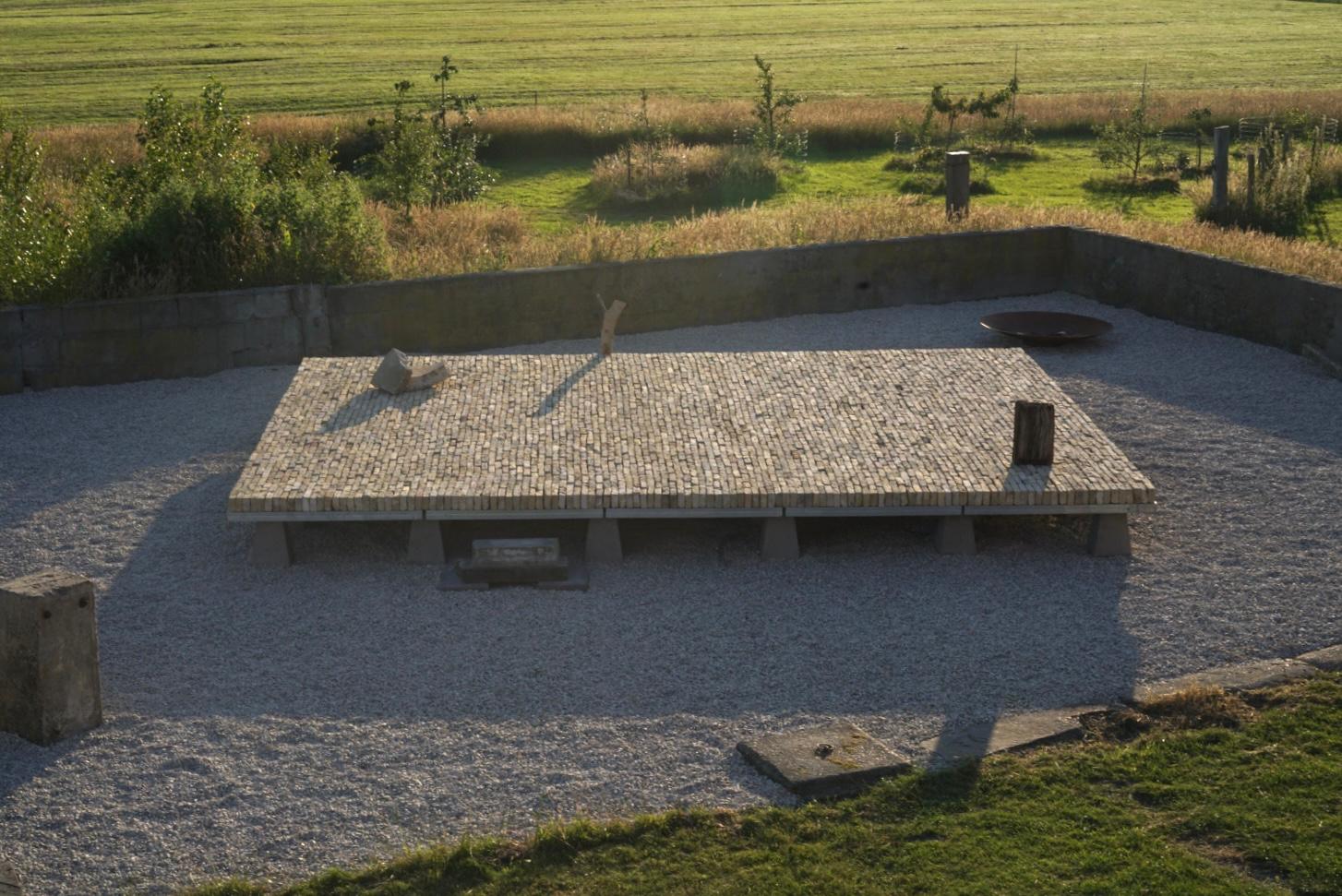
Land, Labor, Love consists of a raised platform made from recycled ‘Friese geeltjes’ – yellow clay bricks from Friesland. The bricks derive their distinctive color, and connection to the area, from the clay with which they are made, which is often extracted from riverbanks or dredged from lowlands in the province of Friesland. Sander Wassink salvaged these bricks from the farm and reassembled them to create the flat surface of a platform, echoing the flatness of the landscape. Circularity, reinterpretation, and the development of new meaning are central to Wassink’s practice. Born in Friesland and now living in Japan, where he developed an interest in platforms, how subtle changes in elevation can imbue everyday objects with meaning, as demonstrated both physically and symbolically by the ‘ordinary yellow Frisian bricks’ in Land, Labor, Love. The platform rests on a simple construction and references to traditional building traditions, but in inverted form: a wall becomes a floating horizontal plane. What was once hidden is now exposed to view. The yellow bricks hereby provide a surface – somewhere to sit, congregate, take a break. The platform stands as a contemporary terp inspired by the landscape and the connection between people and place.