Contamination is the memory of a landscape. Especially in this equilateral triangular shaped land. The small forest is enclosed by a natural burial grave site, national park Hoge Veluwe and an agricultural field that reminds most of an uninhabitable desert. The land is divided in these different functions by barbed wired fences and mapped out by straight roads of asphalt. When we come closer a two meter high green stripe, that is barely distinguishable from the dense vegetation, dooms up, this land is also detached from it’s surrounding. The fence seems to be swallowed up by the vegetation, over decades it is overgrown by bushes and ivy. Visually the triangular forest appears to be part of one extensive natural environment, legally it is not, it is claimed land. The fences make the landscape not only closed to humans, but impenetrable for the wildlife in the area as well. With the result the different area’s in the surrounding are not one landscape, but they functions as reservations. The national parks enclose the territory that is assigned to wildlife. As a result that what is fenced out, the negative space, the roads of asphalt and built-up area of brick and stone, is the reserve for humans.
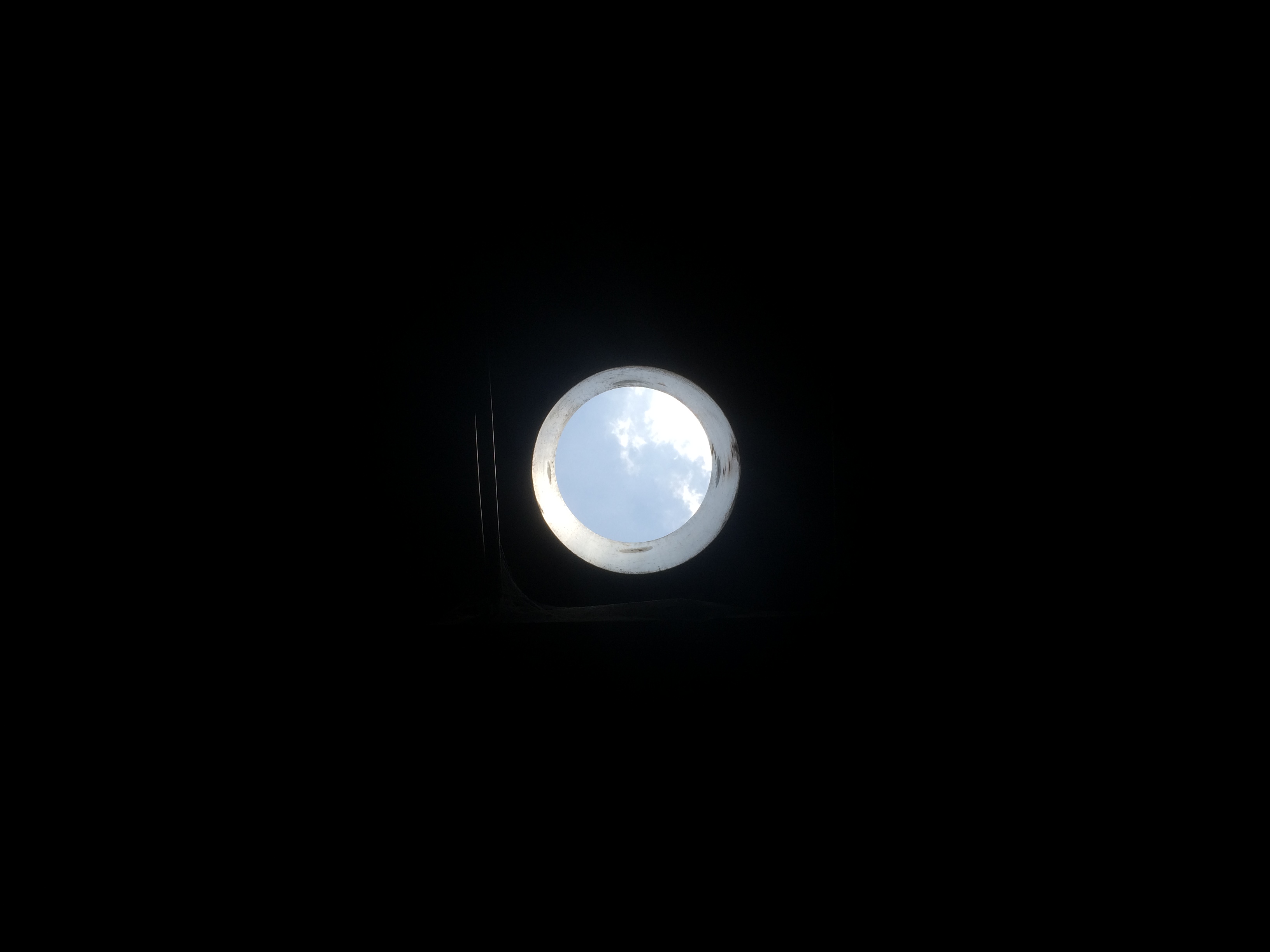
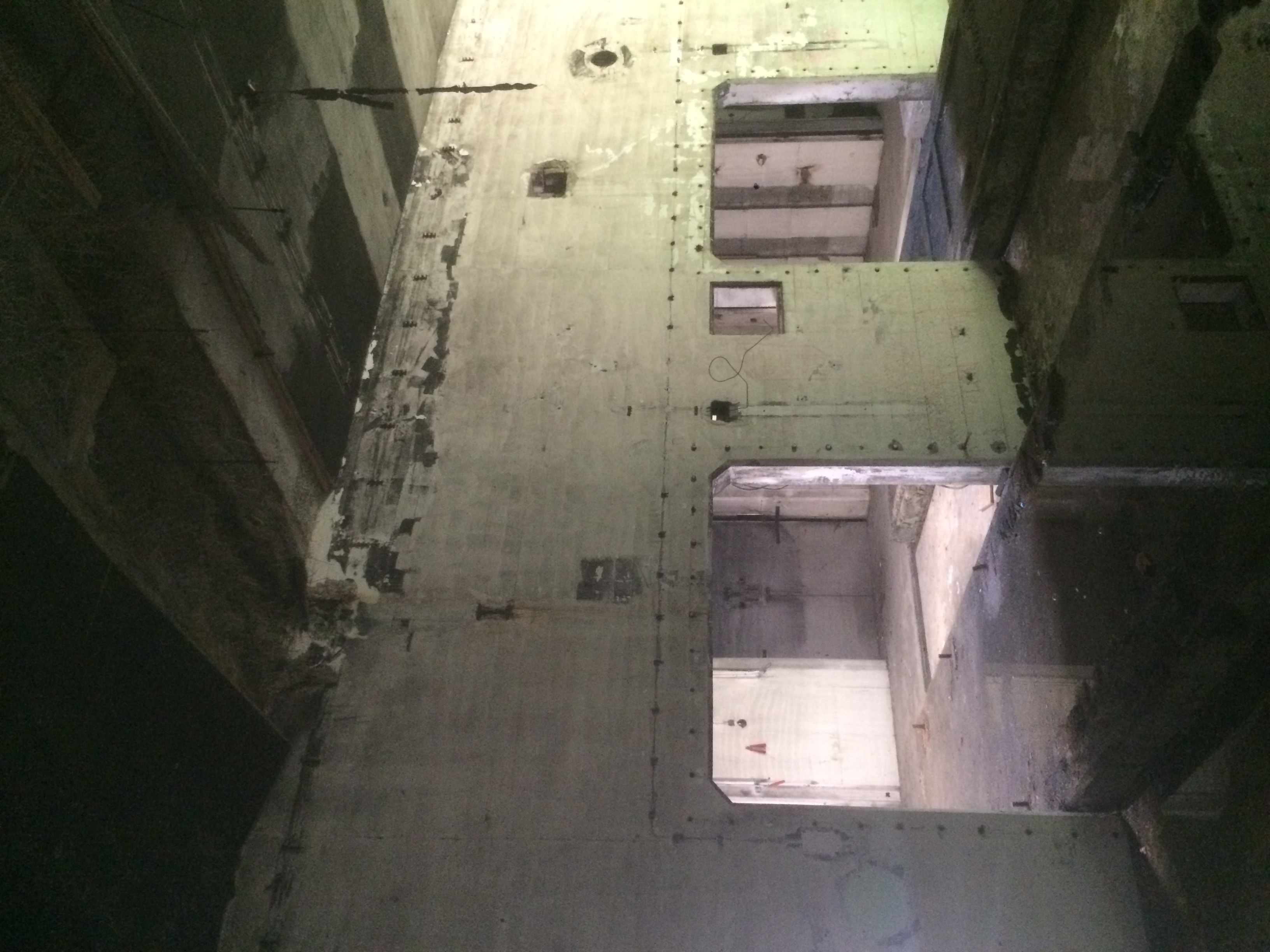
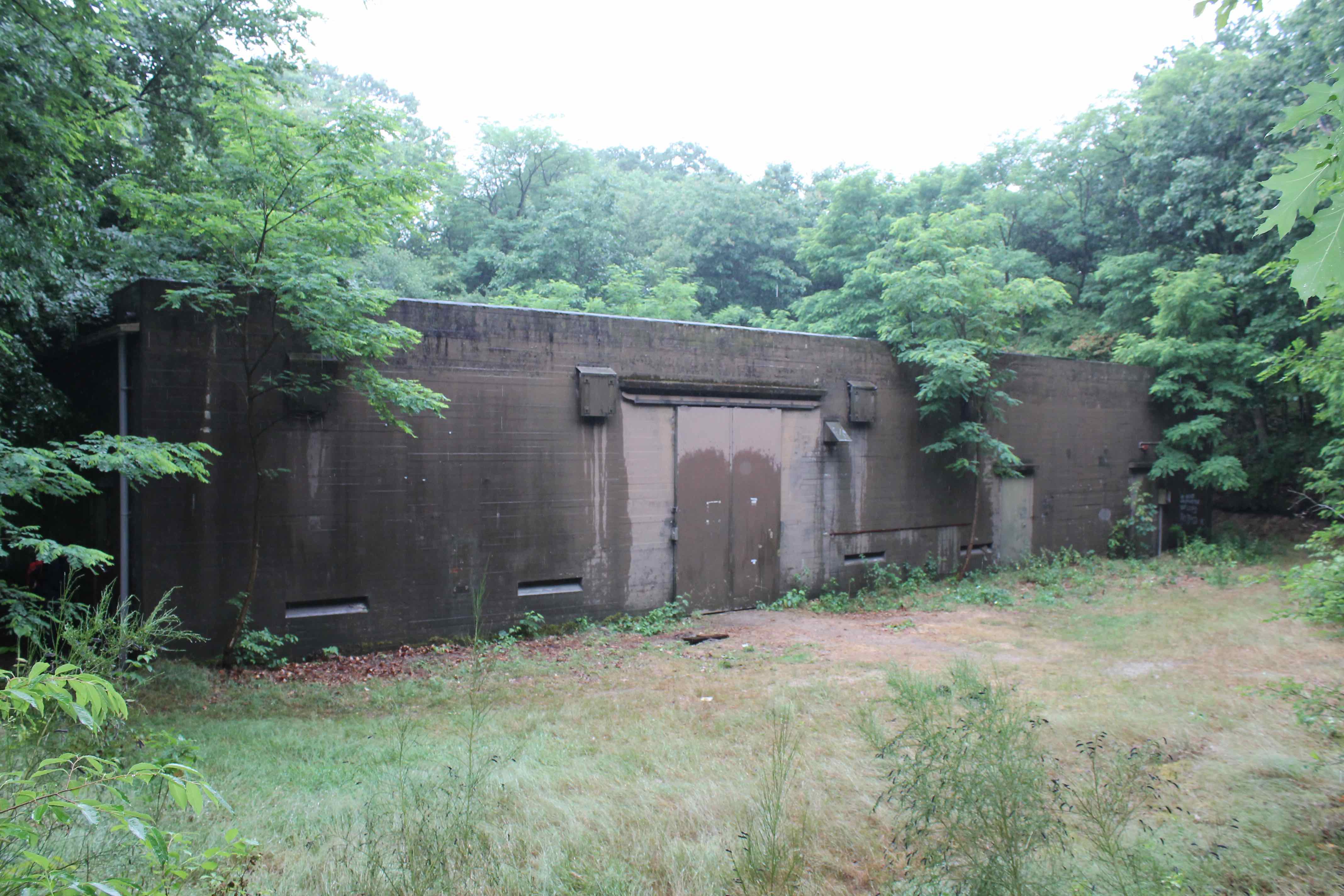
Past the gate a counter clockwise curved road continues deeper into the thinning forest. The path seems to sink underground as the ground rises next to it. The end of the road, hidden by a spiral embankment, reveals an empty circular area, covered with asphalt and sand. In the middle of the open area stands a shoebox shaped concrete bunker of twelve meters wide, twenty-six meters long and five meters high. There are no windows in the building, only four big metal doors from the ground to the ceiling. From the inside the bunker looks like a worn down empty cellar with chipped walls. In this landscape contamination is not a long forgotten recollection; you can simply smell the petrol.
The concrete building is a former NATO booster station. After the Cold War conflict expanded in the 1950s of last century, as a result of the Korean War and the Suez Crisis, the pumping station was built. It was part of hidden network of fuel pipes transporting gasoline, kerosene and diesel across Europe. This specific booster station, with the military description 5VEP, pumped the fuel from the port of Rotterdam to the nearby military airport Deelen Air Base on the Veluwe and to the next booster station Markelo, that pumped the secret fuel further, into Germany. By the end of the Cold War this station became useless. The air base was closed and due to newly available pumping techniques the extra boost from this station was not necessary anymore to reach Markelo. The military decided to move out.
In 2001 three big expensive pumping engines were taken out and the rest of the interior was dismantled. The five underground tanks, three for diesel and kerosene, one for diesel fuel and one for waste oil, were removed in 2005, after which the soil was decontaminated. In 2012 the conclusion was drawn by the State of the Netherlands that the pollution of the soil reached a ‘stable final situation’ and there was no extra follow up necessary to change this small forest ‘back to nature’. Today the former Cold War booster station is a ruin; completely trashed, abandoned and turned to waste. The ruin seems currently worthless. It is for sale by the Rijksvastgoedbedrijf, the real estate department of the Dutch State, for the highest bid.
For a few years we have been searching for a piece of land. Some soil where we can live on, a ground that we can shape, a lot to build on. Not a land to claim for a preordained plan, a part of nature to take precedence over or a place to extract wealth from. This land is worthless for the Dutch State, they are unable to see value in this soil, in terms of money and it terms of social value. The question remains, for us and other potential bidders; What to make of this land?
The offer of the Rijksvastgoedbedrijf is a rather contradictory object; an industrial military contaminated fuel pumping station on a highly protected and restricted natural site. Should the ruin be demolished? This is a possibility as the bunker has no monument status, it is not claimed by the State as cultural property in order to exist ‘forever’. This does erase the memory of the landscape, but not from the surface of the earth. The demolished polluted concrete has to go somewhere else, probably dumped at some other, more invisible land. After that a new building can be build. In this case the land can be commodified, for own profit.
Or should the land be brought back to its pre-existing state, back to nature? Nature and culture are in this case perceived as acting in a hierarchy, culture is built upon a pure untainted nature. But that doesn’t mean it works the other way around to. When culture is removed from a landscape, not nature remains, but a mess, a ruin of modernity. And again this would only be financially beneficial for the owner of the land. In The Netherlands it is possible to abandon your land, to create a ruin of modernity, and get paid for it. It is possible to sell a lot, with for example an agricultural destiny, to the Dutch State as a nature site. The State reimburses the value difference, in this example fifty-thousand euro per acre. The former owner only has to remove the fences and the Christmas tree plantation or potato field is officially designated; nature.
And even if the triangular landscape should be brought back to nature, to which one? The nature of the grave site, of the national park or of the agriculture? These questions address the so called ‘forward march of progress’ of this landscape (Latour, 81). We want to break with this line of thought. We look for a landscape we can react on and investigate, we, both artists, look for land to co-create with. To explore the inherent qualities the landscape has to offer. We want to consider this land as an actor; a non-human co-creator. We don’t want to directly change anything, in other words we want to ‘stay with the trouble’ (Haraway 54). For this reason we are interested in this triangular land, in this small polluted forest. We ask ourselves; how to live on this contaminated landscape?
Contamination should not be considered as negative, or positive for that matter. Anna Tsing writes in The Mushroom at the End of the World; ’contamination makes diversity'. Contamination is not so much a value judgment, such as pollution, but the inevitable process of living matter. Humans and non-humans, plants and soil 'change through our collaborations both within and across species’. She continues; ’contamination creates forests, transforming them in the process' (Tsing 29-30). In other words; the landscapes we inhabit are the result of contamination.
Transformation through contamination created the soil of the Veluwe. During the last ice age, up to twelve thousand years ago, the area was full of mud that was pressed by big heavy glaciers into hills and valleys, as a result the push moraine shape of the Veluwe was created. At that time the North Sea was dried up and consisted of an enormous polar desert. For tens of thousands of years this sand was blown up and carried by the wind, covering, what we call now, The Netherlands. After the ice age the sea level rose deep into The Netherlands, creating the large area of sand dunes that are to this day visible in the national park. Tides that span thousands of years the sea created layers of clay on the soil through sedimentation. This different types of clay and sand make the soil which we now describe as; Hoge Veluwe. There is no evolution of isolated landscapes.
Accepting contamination as the building stone of this triangular landscape, and investigating its impact on the current situation could result into a more profound understanding of what it means to inhabit this landscape. So what kind of landscape is this, what is hidden under the soil?
In Knowing Waste: Towards an Inhuman Epistomology Myra. J. Hird expresses the value and importance of waste. 'Before use, the object is a desirable commodity; afterwards it is garbage. What makes things garbage is their unusability or worthlessness to human purposes. As such, no entity is in its essence waste, and all entities are potentially waste'. She especially addresses a society's preoccupation with removing waste, according to Hird, this need for concealment shows that this society has ‘something important to hide from itself’ (Hird 455).
Obviously, the Western society concealed a secret pipe network that provided the North Atlantic Alliance with fuel for air and ground vehicles during the Cold War. The remains of the underground system are still owned by NATO and brought together under the Central European Pipeline System (CEPS). These fuel pipes run from The Netherlands, Belgium and Luxembourg into, formerly with a capital letter, west Germany and down to the south of France, with a total length of 5314 kilometers. Currently the NATO mainly rents out their military network to civic airports in Amsterdam, Brussels, Frankfurt and Zurich. The Dutch government obscured 5VEP from being visible from the road by building a five meter high embankment around it. During its use the roof was covered with a layer of sand to hide the station from aerial view. Of course the Western society didn’t hide the network or the booster station from itself but from possible enemy attacks. The mobilization and impact of NATO military operations were and are very much dependent on diesel and kerosene for ground and air transportation. Without fuel no mobility and without mobility an army is paralyzed, something the Second World War already clearly demonstrated.
At the same time a hidden toxic system, like the distribution of liquid fuels, does make its users oblivious to the effects these substances have on an environment. This alienation to the pollution of crude oil based substances become apparent to me in the art installation 20:50 by Richard Wilson. In Saatchi Gallery a room was filled halfway with raw oil. Via a descending trench it was possible to walk into this black pool. The smell and fumes of this toxic bath were so penetrant that my nose and eyes started burning, it wasn’t possible to stay in this space for more than a minute. In contrast to this artwork the total oil industry is obscured. On a large intercontinental scale; from the production in refineries to the world wide transportation, the storage in mega-tanks and the distribution to countless filling stations. Up to the very small tactile scale; the fuel dispenser we hold, the shiny surface of our cars and the smooth gear stick. Accept for a faint smell, the thick toxic liquid fuel is always hidden from sight.
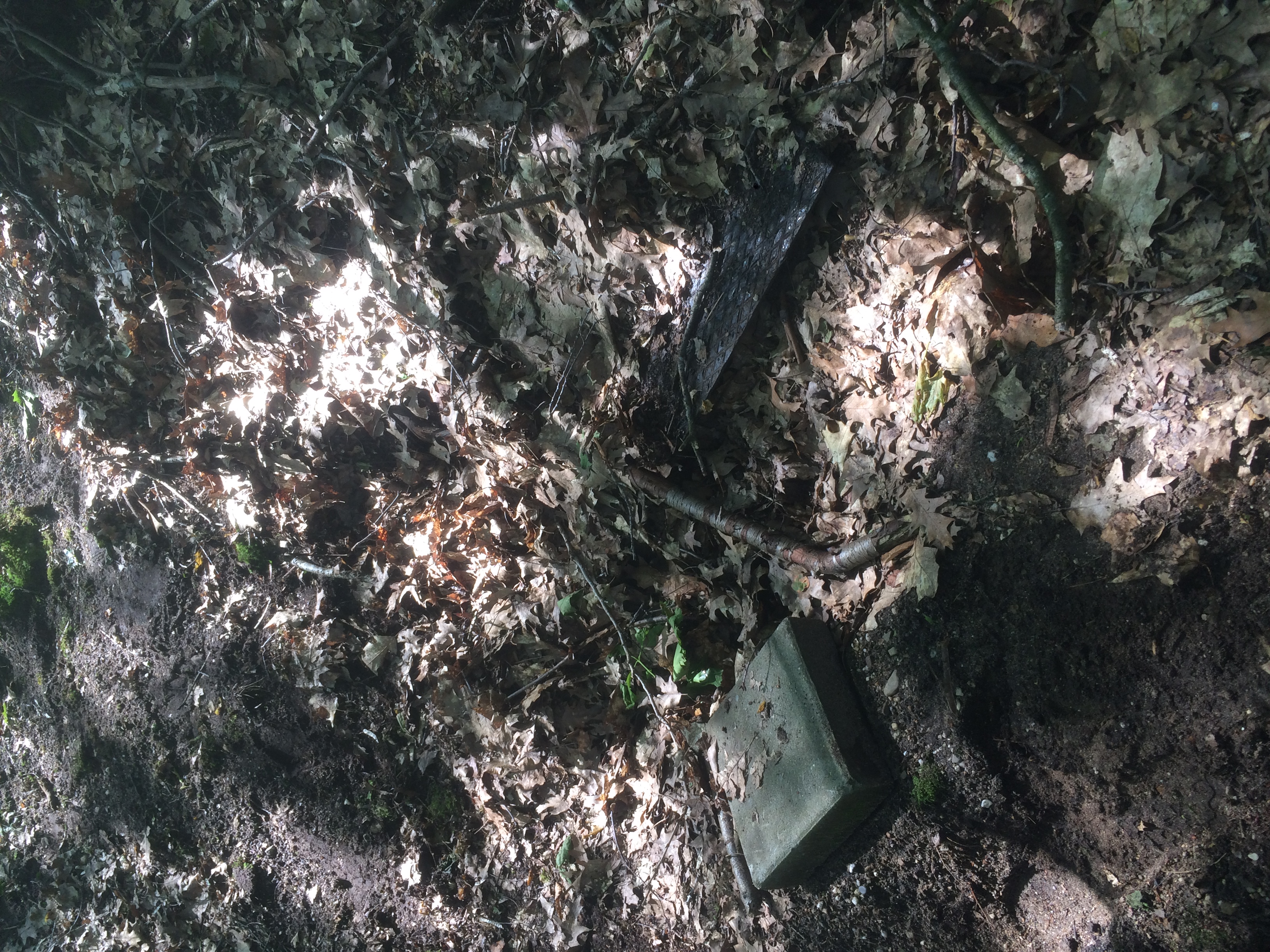
The same camouflage technique is applied to the polluted earth around the ruin. The storage and handling of liquid fuels over several decades left the ground heavily contaminated. According to the most recent soil status rapports the ‘Critical Zone’, as Bruno Latour describes the thin biosphere layer of our planet that all species co-inhabit, is polluted up to 16 meters deep (Latour 93). Next to that is it forbidden to extract water up to 25 meters deep under the topsoil horizon. The entire depth is regarded as polluted and a danger to the humans species. In reaction to this severe soil contamination the Dutch State remediated the top fifty centimeters of the earth and concluded soil status as ‘stable’. Clearly the Dutch State has a different view on what is to be considered a ‘critical zone’ and a healthy and balanced ecosystem.
In a matter of decades the layers of clay and sand, that took thousands of years to become the Dutch soil as we know it now, is ruined. The duty of care that rest the upon this land the coming decades, or maybe longer, legally prohibits contact with the contaminated earth under half a meter. Obviously not all species follow the rules of law; flowers, trees, insects and animals will not only get in contact with the surface. A polluted landscape is for our society not a problem, as long as it is hidden under a layer of dirt.
This particular triangular ruined landscape brings another, more deeply rooted, concealment of our society to the surface. The Netherlands is very much 'preoccupied', as Hird puts it, to restore certain area's 'back to nature'. A big percentage of green landscapes in The Netherlands are defined as protected regions. These lands are under the strict rules of Natura 2000, set out by the European Union in 2000, in order to create long-term safe habitats for rare and threatened species. Among these natural reservations are for example the polders directly north of the highway ring around Amsterdam, the entire coast line, the Wadden Island, the Oostvaardersplassen and the Hoge Veluwe.
The irony is of course is that there is no such thing as true or real nature in The Netherlands. The national park Hoge Veluwe is originated and cultivated by an art collector. The biggest natural reserve, the Oostvaardersplassen, is located on the Flevoland. This is the biggest artificial island of the world, it is man made in the 1960s by enclosing and afterwards draining of the Zuiderzee. Even the animals are man made in this 'natural' park; a human bred cattle species is imported in the 1980s named after their inventor Heck who wanted to breed back an extinct large wild cattle. The polders are ‘reclaimed’, the forests are planted and the dunes are elevated to break the tides that flooded the small parts of land rising out of the swamp. As they say; God created the earth, the Dutch created The Netherlands.
The Dutch soil is not a primal type of nature, but at the same time isn't solely an artificial cultural constructions either. They could be considered hybrids, or as Bruno Latour defines them in his book We Have Never Been Modern; quasi-objects (Latour 88). According to Latour a dualistic distinction between nature and society was made, at the start of modernity in the seventeenth century, in order to have better control over these two domains. In contrast to pre-modern societies, where rain dances and astrology were considered as true as the 'laws of nature’. In the modern era object and subject are unmistakably set apart. As a result 'nature' and 'culture' became two separate entities that could not be merged.
In our current age we became more aware that there is not such a clear distinction between nature and culture. Scientific laws that seem to describe the nature around us in objective formulae have been critiqued by postcolonial studies and feminist theory. Leading to the counterintuitive but relevant situation that we should ask ourselves the question if Newton's laws of gravity could be merely applicable to a white English male. But next to these epistemological issues, when we simply look at phenomena around us it is not so simple to draw a line between a natural and cultural origin. Our world is full of hybrids of natural and cultural agents; the ozone hole, the ebola virus, global warming and the 'nature' of the Netherlands. It is impossible in these examples to separate nature and culture. Instead Latour suggests to redefine the distinction of these two opposites and with that the definition of modernity itself. The two ends of a nature-culture spectrum are not separate but always entangled. For this reason he doesn't use 'nature' or 'culture' but merge them, both philosophically and etymologically, into a new definition; 'natureculture'.
A good example of the entanglement of nature and culture and an inevitable renegotiation of natureculture, is visible in the controversial return of the wolf to the Netherlands. After more than a century the wolf is back. Since last year the female grey wolf, aptly named by humans as GW998f, made her appearance in the Veluwe by killing a few sheep. The simple fact that the wolf is actually present at the moment leads to a renegotiation of the relation between nature and culture. On one hand the wolf is not an animal which you can simply breed or import from another country, it is acting out of his or her own instinct, this very much represents our idea of wilderness. But at the same time natural protective laws, like Natura 2000, create conditions for a habitat in which the wolf can strive. The removal of fences, the construction of eco-ducts and, maybe most importantly, the for now forthcoming reimbursement of lost profit due to the 'natural' dead of livestock by attacks of wolfs. Cattle farmers are against the return of the wolf, mostly because future investments have to be made to protect their living property, and add stories and rumors of fear for human victims. While ecological organizations, pleading for more biodiversity in the Dutch landscape, see the return of the wolf as a proof that despite the appropriation of land by industry, cities and farmers, nature always grows in between the cracks of civilization. Modernistic principles that entail the control of nature are as unsustainable as the conviction that we can let the wilderness take care of itself. This discussion leads to a fruitful negotiation of who owns the land.
The goal of this symbiosis of non-humans and humans is not in order to be a reactionary, to go back to a pre-modern world. As in these era's society and nature were not clearly defined and merged into each other differently on small adjacent territories. The goal is not to discard any distinction between nature and culture, not even to dismiss them both as autonomous agents. The goal is to acknowledge a mutual construction of cultural and natural agents. This negotiation leads to delay, moderation and regulations, in other words, a responsibility, from which we can expect new moral values (Latour 234).
In this line of thought the contaminated triangular landscape cannot be brought back to a pre-existing nature without human interference, this nature is not natural anymore. But at the same time natureculture gives human culture agency for damage control. For example fences can be adjusted for better wildlife mobility or taken out in their entirety. Or the polluted soil is not only cleaned when excavated and dumped out of sight, more slow and natural on-site processes of decontamination with the use of fungi and bacteria are more beneficial for both human (profit) and non-human (survival). This way of thinking in hybrids leads to a better understanding of what to do with this triangular contaminated landscape.
In the collection of essays Arts of Living on a Damaged Planet, edited by Ann Tsing, Heather Swanson, Elaine Gan and Nils Bubandt, our current post-Anthropocene epoch is investigated through the concept of Ghosts. All contributors have moved beyond the discussion if there is a human caused geological force at play. For them it is a fact, a view on our common world that I share. You don't need to read all the IPCC reports to understand that humans have a big impact on the Critical Zone. Especially since the Great Acceleration, the sharp rise in the destructive environmental effects of human industry since the second half of the twentieth century.
They write; ’Every landscape is haunted by past ways of life’, 'forgetting in itself remakes landscapes, as we privilege some assemblages over others. Yet ghosts remind us. Ghosts point to our forgetting, showing us how living landscapes are imbued with earlier tracks and traces' (Tsing et al. G2 - G6). This way of understanding a landscape shows different histories where one history is not preferred over the other. They come together in the present. These different temporalities reveal the same impossibility of modernity, as Latour addresses in We have never been modern. Modernity trained us to look forward, to the endless horizon of progress. But as the haunted landscapes we inhabit tell us, this kind of progress has to be radically reimagined ‘because they are already here’ (Tsing et al. G12). Ironically the famous quote of Marshall McLuhan, proclaimed in the heydays of modernity; ‘We look at our present in the rear-view mirror. We march backwards into the future’, should be taken seriously and as praise (McLuhan 75). The triangular landscape is a ghost of modernity, a haunted landscape that troubles the narratives of Progress (Tsing et al. G12). The contamination of the land stagnates the fable of an endless continuation of Progress, but reveals at the same time other ways of living that have been ignored and damaged.
Even though modernity plundered and almost destroyed every known nature and culture on earth, Latour argues, modernity also brought us an expansion of hybrids. Through this expansion new networks and productions of tracks have been created that shows a world co-inhabited by humans and non-humans. This conviction leads to new ways of thinking that will be crucial to survive a future where we have to live on a damaged planet.
The most obvious plans for the triangular landscape, such as the cultural heritage preservation of the bunker, demolition followed by real estate development, material extraction from wood harvesting or agriculture and nature ‘restoration’, all negate the inherent conflict that arises when this possible purchase is seen as a problem of choosing nature over culture, or vice versa. These development plans deny the existence of hybrid objects. When transformation as contamination is embraced and the existence of hybrid objects is accepted, the ruin of the former Cold War booster station and the polluted triangular forest can be seen as a symbol of 'the situation of our world’ and ‘the ruin that has become our collective home’ (Tsing 3-4).
We want to turn it around, make from the problem the solution, as a first step into the Chthulucene, the epoch following the Anthropocene were humans and non-humans have to co-inhabit the earth in symbiosis, in contrast to extraction (Haraway 55). We don’t want to demolish the concrete structure, we want to remember this ghost, this symbol of modernity and let it evolve into a new structure. We don’t want to discard any material, we want to recycle every part of it plastic and metal. We don’t want to extract new materials, we want use the cut trees and to be demolished buildings in the surrounding. We don’t want to throw away the contaminated materials, we want to contain them as a burden. We don’t want to dispose of the polluted land, we want to decontaminate it over long periods of time. We want to live within this damaged landscape, we believe that is the highest bid.