
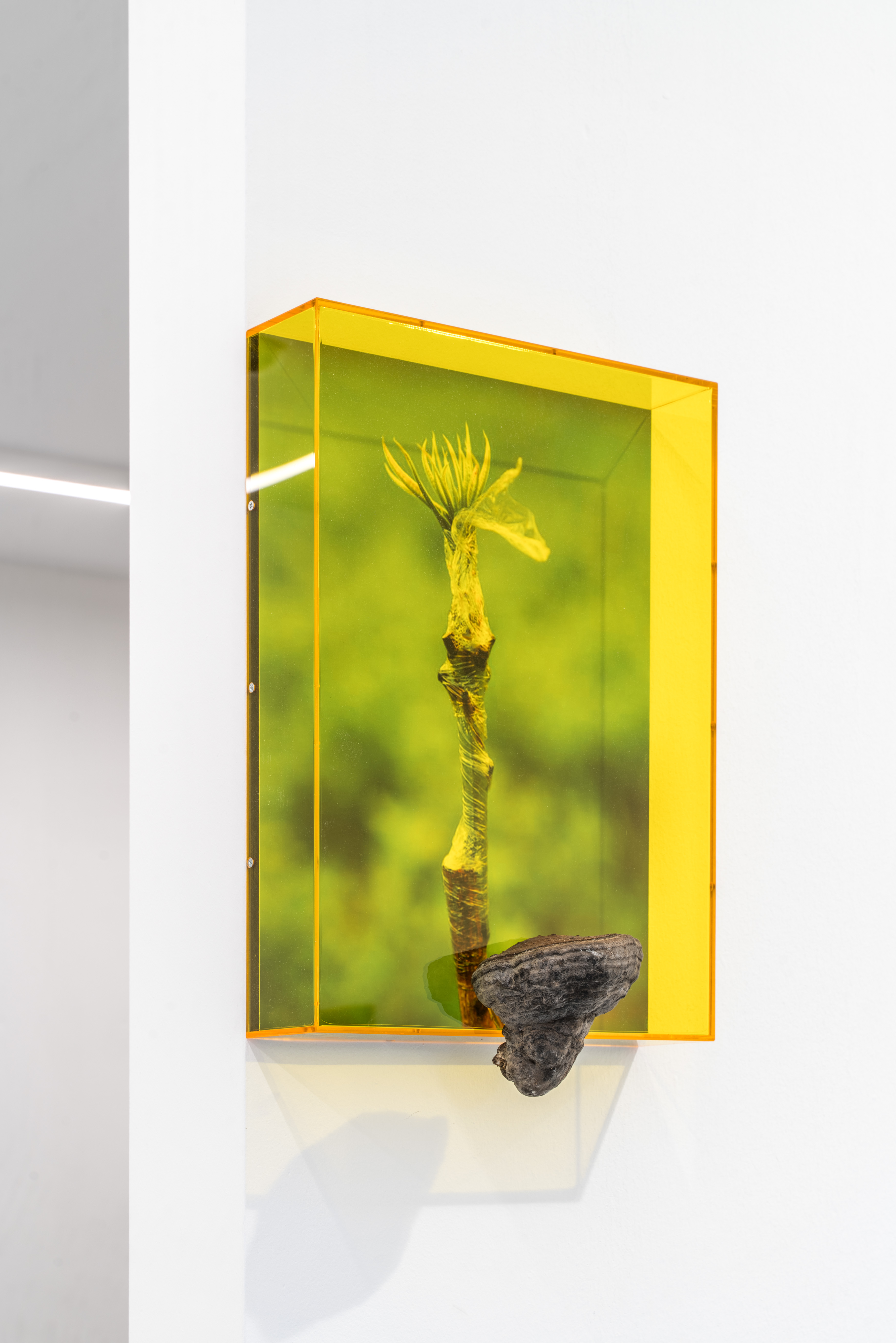
This essay is written for the exhibition Four floating patches, secondary shoots, 2020, by Vincent van Velsen
In the practice of Saskia Noor van Imhoff systems are of main essence. With her exhibitions and individual works she reflects on rules and regulations that make for our conditions of living. This entails reflections on man-made structures: the ways we are educated and disciplined through knowledge systems, (in)formalities of culture and, manmade structures that systematically classify and differentiate. These are the artificial categories created for distinctive purpose that order our environment and allocate value. This includes differentation between here and there, then and now, human and nature, commodity and waste, objects and materials or, plant and animal species. Her practice is concerned with the fundamental architecture of our existence In an art context this would include the modes of selection, curating and preservation regarding art works and collections: the considerations that make for the political forces that ascribe value and produce appreciation and (re)presentation of art.
Sampling is the process of extracting recorded sound and reusing those sounds in a new recorded sound product. The use of digital recording technology to manipulate existing recorded sounds has roots in Pierre Schaeffer’s musique concrète of the 1950s as well as audio collages. In the 1970s, street DJs in the Bronx began mixing, looping, backspinning, quick-mixing , and scratching. Regardless of their length and recognizability, producers use samples in a variety of ways when transplanting them into a new context. // Each producer, then, is always negotiating a multiplicity of relationships to the past, [...] while inhabiting the present. [...] Agency in sampling is bound to the notion of freeplay, remodelled in the image of the rhizome over the arbor, relocated to the connections between sounds rather than the source. Disparate source material can always be made coherent, no matter if that disparity is measured musically, generically or socially. // The spectre of the sample haunts its semiosis in its new location, the present tracing the past even as a fissure splits it from that past. The resituation of the sample in its new context is a moment of rupture and play. Where play demarcates the space of jointedness or articulation, rupture describes the moment of severance between past and present. (Vanessa Chang in Records that play: the present past in sampling practice).
Recently, Van Imhoff has shifted her focus from the frameworks of the white cube towards an outdoor space just outside of Amsterdam that she is currently using as an open air studio. It concerns a small strip of land that prior to her arrival was subject to a sense of neglect, as little energy was invested in any type of upkeep and the plot was mainly used as a dumping ground for all types of left over materials. These circumstances provided Van Imhoff with the possibility to further expand on her interest in traces and remnants. Since, she has been digging and planting, sanitising the soil and creating a space that is fit for cultivation. During this process she discovered vestiges of former use. And throughout she has been documenting and archiving her findings, activities and own additions. Four Floating patches, secondary shoots centers this process of restoring and reshaping at the long-neglected and contaminated tract.
For this first translation towards an exhibition, Van Imhoff has used her examinations of the growth of plant life and the evidence of past activity embedded in the soil. The ground tells a story of human and nonhuman interactions. The artist interpreted this narrative and complemented it with archival materials; amongst which maps and historical documents. She has used these patches of information to construct her understanding of the terrain and contribute to a layered, visual conception of the plot of land. At the same time she questions the way we have constructed different types of perceptions to visually repesent a given situation. These ways of mapping and carthography – including their digital renderings – shape our perspectives and knowledge concerning our surroundings. In the same way, Van Imhoff utilizes display methods that are normally used as ways to (re)presentat objects that are considered valuable. Within this explicitly designed environment, the artist poses the suggestions of new discoveries. She creates a tension with meticulously presenting discarded everyday objects as if they were the most valuable excavated artefacts. A gesture through which she brings underlying power structures of valorisation, selection and conservation to both the literal and symbolic surface.
An important focal point of Four Floating patches, secondary shoots is the ways objects carry an entire history within themselves. As they have withstood the test of time and represent their origin, evolution and current state – simultaneously. Their trajectory through time, its traces, their former use and wherabouts are present in this one appearance through marks, substance and composure. Precisely this contemporary presence is relevant to the artist. The objects that she presents are fragments and representations of all their prior states and forms, including symbolic and projected meanings, compressed into a single physical chunck of matter in the present. In the collection of essays Arts of Living on a Damaged Planet (eds. Anna Tsing, Heather Swanson, Elaine Gan and, Nils Bubandt) state that ’every landscape is haunted by past ways of life’, 'forgetting in itself remakes landscapes, as we privilege some assemblages over others. Yet ghosts remind us. Ghosts point to our forgetting, showing us how living landscapes are imbued with earlier tracks and traces'. In the same way objects contain ghost images: imprints that linger within the material structure of an object that are not necessarily derivable by the human eye, as they might also have repercussions beyond surface. In earlier works, Van Imhoff for example used X-Ray methods to trace these formations and make them visible through photographic means. In general she shows the physical layering of material and objects; of which some, eventhough discarded, seem to be still in flux, alive and growing – continuously adding to what existed before.
Grafting perhaps represents the most fascinating aspect of conventional propagating techniques. It forms a very important stage in the production of both open-ground and container-grown plants, and is one reason why so many choice and unusual plants forms can be offered on the retail market today. Within a wider context, grafting has many varied horticultural applications besides nursery production, including, for example, fruit growing greenhouse production and, ocassionally – in the amenity field – repairing damaged trees. It may occur naturally – shoot or root system of certain plants can join together if they are growing in an over-crowded situation and if the growth patterns of the outer tissues are in the same direction. Successful grafting in the modern nursery requires that the propagator demonstrate considerable proficiency technique, with sound basic instruction followed by wide experience to attain a high degree of competence and speed. It also requires knowledge of scion/rootstock compatibility and an in-built ability to care for the grafts until the union has formed, and a detailed knowledge of the requirements and growth patterns of individual plants. (Bruce MacDonald in Practical Woody Plant Propagation for Nursery Growers).
In this relation, Karen Barad speaks about cuting up the coordinates of space, time and matter which all together become the concept of spacetimemattering. She speaks about “co-existing multiplicities of entangled relations of past-present-future-here-there that constitute the wordly phenomena we too often mistake as things existing here-now”. Barad makes us aware that we all inhabit the same space, a shared environment in which nothing is independent, autonomous or purely itself as “the world is made of entanglements of “social” and “natural” agencies, where the distinction between the two emerges out of specific intra-actions”. And describes intra-activity as “an inexhaustible dynamism that configures and reconfigures relations of space-time-matter”. Arising from these concepts Barad introduces quantum hauntology: “to think with and through dis/continuity, to render time and space out of joint, to entangle the here and now, the then and there”.
It is exactly this type of interrelationship that Sakia Noor van Imhoff points at. She adresses this spacetime – that is often called history – by connecting it to exchange, traces and remnants on a larger scale. She refers to methods of plant propagation to produce work. In this context of art, botany and propagation,Van Imhoff posits grafting as her main metaphor for the progress of culture. She sees the manipulation of the landscape as a kind of grafting, deepening the relationship between people and place, a relationship through which the concept of nature is borne. As one moves through the gallery space, each artwork creates a new focal point to include representations of the land and its flora, found objects extracted from the environment, and replicas of organic material. Here, these discrete concentrations of information take on character as hybrid forms, viable prosthesis and grafted indications of value. Hence, the exhibition questions our expectations and considerations relating to nature and a cultivated plot of land in a white cube presentation.